Showing posts with label travel. Show all posts

Monday, August 19, 2013

Winding down...book discussions and Persuasion.

I appreciated this hot day, and I will enjoy the ones that are to follow, but I have to face reality: Summer is winding down, and with it, mah blurg. I've read eight full books, three essays, and a smattering of assorted Austen-related goodies, and written about a fraction of them.

Today was really special. I had a book discussion on Northanger Abbey with four intelligent, well-read friends. We shared tea, cheese and crackers, and cookies while talking over our favorite things about NA (the "case for innocence," the punctuation and "tastefully ornamental" sentences, and of course, her sharp irony) and differing opinions on Henry Tilney (by turns a "dreamy" educator who really helps improve Catherine's worldview and "a condescending man-splainer"--but nowhere near as bad as this guy). I felt really lucky to have friends who wanted to spend time talking about Austen. And another exciting thing that came from this: We will be meeting in a few months to discuss Mansfield Park! It was a lovely afternoon. I felt so happy before the discussion, after picking up flowers and walking home with a bag of cookies from a local bakery in my hand. I was happy that this was my life: Baked goods, fresh-cut flowers, and a book discussion.

So, to rewind: While on vacation I read Persuasion, which was the first Austen work I read, back with the brilliant Mr. Youngblood in my high-school English class (and apart from his intelligence and influence, he is a total silver fox). I wanted to read it last for that reason (not the silver fox reason), but also because it was her last novel, her oldest heroine, and her most "autumnal." It's important to be seasonal, as anyone who has seen the costumes in Far From Heaven can tell you.

Rocking the fall color palette. 

It was difficult to find time to read on the vacation. I started the novel on the ride to St. John, but once there had trouble reading more than a page or two at a time. What with the views, the people, and the claims of the salt-water pools (where you could open your eyes underwater without it burning!), it was hard to read more than a paragraph without losing my place. And if I decided to really SIT DOWN AND READ, I did so in a hammock, where I promptly fell asleep. But boy, I tried! I took it everywhere--by the pool, on the boat, to various beaches. In a box, with a fox....One of my parents used it as a coaster when I wasn't looking. And it's not even my book, so keep that in mind if I ask to borrow a book.

Maybe it was the distractions, but I had a bit of trouble keeping track of people in this book. Coming off of E, especially, it seemed there were more families and groupings than usual. I found myself confusing the Crofts and the Harvilles--there were so many navy characters!

I liked that Anne Elliot, who was passive, calm, and reserved, was drawn to men who were warm and forthright. She was more suspicious of charm than the younger Austen heroines, who are initially drawn in by the Wickhams, Willoughbys, and Churchills. Anne observed of her cousin: "[He] was rational, discreet, polished--but he was not open. There was never any burst of feeling, any warmth of indignation or delight, at the evil or good of others. This, to Anne, was a decided imperfection. [...] She felt that she could so much more depend upon the sincerity of those who sometimes looked or said a careless or a hasty thing, than of those whose presence of mind never varied, whose tongue never slipped" (end of chap. 17). I like this sum-up of personality quite a bit, and find it interesting that Anne herself is such a composed, private person, unlike Louisa or Henrietta, the girls who you could view as warm and frank, but are seen as imprudent. I think that the above observation is something that holds true in almost all of Austen's novels--the men who are the most lovable are the ones who are the least polished, and they're often awkward.

Amy Smith, in her travelogue All Roads Lead to Austen, talks about how the men in Austen are never Prince Charming, rather, what makes them the hero is more a question of "fit;" a yin-yang match for the heroine. A partner who can balance and improve the other is the ideal. The Crofts provide an example of a happy couple: they do everything together, they are true partners. Mrs. Croft corrects the enthusiastic but sometimes careless driving of the Admiral, and he....I'm not quite sure what he does for her, but provide liveliness and good cheer. I love that scene, and the depiction of the Crofts. I like that characters are decidedly imperfect, but the romance comes from the idea that a union between people can bring them all closer to perfection.

Thursday, July 18, 2013

Northanger Abbey


Northanger Abbey is a book that means a lot to me. I read it one intense winter, and it was so full of associations even then.

Returning to it with more Austen under my belt changed my reading a little. I was more critical, and the humor this time seemed maybe too distancing. I still really enjoyed it, but some of my pleasure was wrapped up in personal memories and the tactile pleasure of the worn and beautiful 1948 edition I have.

The book, with its cloth-covered binding and thick pages, takes me back five years.

This lady lived in Norwich! And then she brought me to Chicago, in a way.

I was twenty years old and studying in Norwich, England when I first learned about Northanger Abbey. I had heard the title but only had a vague idea what it was about. I mixed it up with my vague knowledge of Wuthering Heights. I was taking a course on Gothic Literature and we were reading The Mysteries of Udolpho, which is the novel that the heroine of NA reads. Our professor told us about Austen's satire on the Gothic Romance, and for awhile that's all I knew. I kept it in mind.

I traveled to London a number of times during the year. On one of my visits to the Tate Museum of Modern Art (which I never did get around to enjoying; it was always too crowded), I met Arthur. He was a volunteer, and an American. I asked him where to check my coat and he asked me to dinner. We went to a restaurant in Sofo, with pounding music and hot waiters. He ordered Veuve Clicquot and invited me to Cape Town for Christmas. I was lonely, and he seemed to be the man of my dreams. He complimented me and treated me with respect. He traveled a lot and had an apartment on the Thames. He was charming, and if you've read any Austen you'll know this should set off alarm bells. Austen wasn't a ready reference for me yet, though I did recognize his charm as "oozey." But it was so exciting.

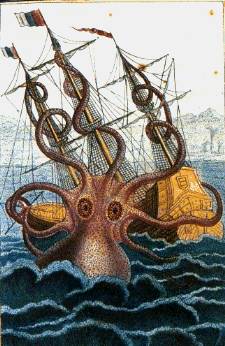
I was as much (if not more) infatuated with his apartment as I was with him. It was beautiful; full of modern furniture, hidden cabinets, and silver buttons. And South Africa became a reality when he bought my ticket. How exotic! I felt like Sally Bowles. I felt like my dreams were coming true. Part of me knew I couldn't be fully happy with an older man I wasn't sexually attracted to (and who bought cheap toilet paper), but I didn't put words to those thoughts, and so they weren't real. It was only later that I would describe him as a "kraken" in angry poetry scribbled in my journal.

I felt like the ship when I slept with him.

Things quickly became tense, and even though I told him I thought I shouldn't go along on his vacation, he told me he really didn't want to go alone. So I flew in cramped coach, grumbling that parents who bring babies on transcontinental flights should be ejected over water, while Arthur reclined in first class. On arrival we barely spoke, except for him to complain about a flight attendant being slow to bring his orange juice or something. I couldn't think of anything polite to say back. He had lost his veneer of charm, and had become crass, insulting, and thoughtless. The first day at the gay resort I spent like Catherine Moreland, unknown and unknowing. I sat by the pool, reading Portrait of the Artist as a Young Man (which is funny, since I was reading Joyce when I switched to Austen this summer).

And along came the co-owner of the resort, to ask how everything was. He was young, handsome, and fun. But mostly he was just interested and active. He wanted to take me to a South African market; he wanted to show me penguins. Arthur, still mad about the orange juice, wanted to nap, so he let me go.

We had lunch overlooking the water and the walls were lined with old books, one of which was Northanger Abbey. I mentioned my interest, and maybe I talked about Gothic lit for awhile. I don't remember. I just remember being happy. We laughed a lot.

The next few days got sordid fast, and though I did nothing other than accepting attention, "trifles light as air are to the jealous confirmations strong as holy writ," and I ended up trading hands in what amounted to a financial transaction between the men. It's not a time I like to think of very much; it makes me sick and sad. But after Arthur left the resort, when Phil and I drove along the coast and up Table Mountain listening to Beyonce's "Smash Into You" I felt lifted up. It was exhilarating. It was the most passionate I had ever felt, and very different from the depressing affairs I had left behind in Cleveland. I had gone from numb and drunk, to in love, to broken, to exhilarated, and finally, disappointed.

Now when I re-read NA, in that edition Phil gave me from the restaurant with his tender inscription, the story of the ordinary, innocent heroine and her mixture of worldly, scheming friends and her educator/lover, as well as her very active imagination and her passivity, reminds me of that Christmas I spent in Cape Town.

Northanger Abbey describes places I walked in Bath so often, like the Crescent, Milsom and Cheap Street. It reminds me so much of England, much like when I re-read After Leaving Mr. MacKenzie and am right back in my room overlooking UEA's pond, drinking Tanqueray. But NA is tied not only with England, but Cape Town, Phil, and my family. There isn't another novel that is so evocative. It connects my personal life with my academic life--both Shakespeare and Gothic, and yet it was read only for pleasure. Of all the Austen novels, NA is the most significant to me. I identified with the exceedingly normal and naive Catherine, but unfortunately, I lacked her basic good sense and strong morals. I was drawn into the "Thorpe"-like web, too attracted to money and adventure. I know I didn't finish the novel while I was in Cape Town, because I feel like the condemnation of Isabella's character may have stung quite a bit.

Though this was more personal and difficult than anything I've shared on this blog, I don't think I would be doing myself justice if I didn't include this part of my relationship with Austen. It may not be perfectly told, but here it is.